
9 States That Don't Tax Retirement Income in 2026
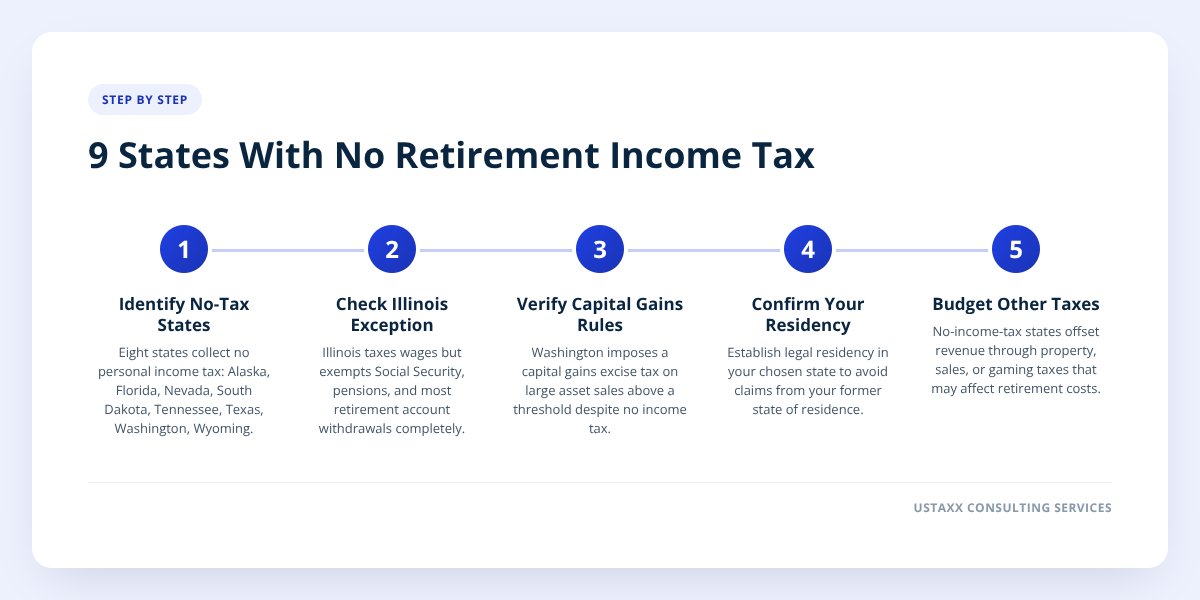
Quick answer: Eight states collect no personal income tax at all, so pensions, 401(k) withdrawals, IRA distributions, and Social Security benefits all pass through untaxed: Alaska, Florida, Nevada, South Dakota, Tennessee, Texas, Washington, and Wyoming. A ninth, Illinois, does tax wages but specifically exempts retirement income — including Social Security, pensions, and most retirement account withdrawals — for its residents. Every other state either taxes retirement income like ordinary income or offers partial exemptions you need to check individually.
Key takeaways
- Eight states have no personal income tax at all: Alaska, Florida, Nevada, South Dakota, Tennessee, Texas, Washington, and Wyoming, according to each state's department of revenue.
- Illinois does not tax Social Security benefits, qualified pension income, or most retirement account distributions for residents, per the Illinois Department of Revenue.
- Washington and New Hampshire-style "no income tax" states may still tax investment gains differently — Washington, for example, applies a capital gains excise tax above a set threshold, per the Washington Department of Revenue.
- No state can tax your federal Social Security benefit out of existence — the federal government, not the states, sets how much of that benefit counts as taxable income in the first place.
Before the list, one clarification worth sitting with: "no tax on retirement income" and "no income tax" are not the same claim. A state can tax wages heavily and still exempt your pension completely — Illinois is the clearest example. A full breakdown of how each state sets its rates and brackets, including states with partial retirement exemptions, is on USTAXX's state income tax guide.
1. Florida
Florida has no personal income tax of any kind, so pensions, 401(k) and IRA withdrawals, annuity payments, and Social Security benefits are never taxed at the state level, according to the Florida Department of Revenue. This applies whether you're drawing a public pension, a private employer pension, or self-funded retirement savings. Florida funds its budget primarily through sales and property taxes instead. For residents who split time between states, confirming Florida residency correctly matters for avoiding a claim from your former state — a topic covered on USTAXX's Florida tax page.
2. Texas
Texas levies no personal income tax, a position written into the Texas Constitution and confirmed by the Texas Comptroller of Public Accounts, so retirement distributions of every kind go untaxed at the state level. The tradeoff is Texas's property tax burden, which ranks among the higher rates nationally according to the Comptroller's own data, something retirees weighing a move should budget for separately from income tax savings. Details on how Texas structures its revenue collection, including for part-year residents, are on the Texas tax page.
3. Tennessee
Tennessee has no tax on wages or retirement income, having fully repealed its Hall Income Tax on interest and dividend income effective January 1, 2021, according to the Tennessee Department of Revenue. Before that repeal, Tennessee taxed investment income even though it never taxed wages or Social Security — a distinction that tripped up retirees who assumed "no income tax" meant no tax on anything. Today the exemption is complete: pensions, IRAs, 401(k)s, and Social Security all pass through free of state tax. More on how Tennessee treats other income types is on the Tennessee tax page.
4. Washington
Washington has no personal income tax, but it is not a blanket exemption for every form of retirement-adjacent income. Washington imposes a capital gains excise tax on long-term capital gains above an annually adjusted threshold, according to the Washington Department of Revenue, which can apply to large one-time asset sales even though it does not touch pension payments, 401(k) withdrawals, or Social Security. Retirees drawing standard retirement account distributions are unaffected; those selling significant investment portfolios should check the current threshold before assuming total exemption. The Washington tax page walks through who the capital gains tax actually reaches.
5. Nevada
Nevada has no personal income tax, funding state government largely through gaming and sales tax revenue, according to the Nevada Department of Taxation. Retirement income of every type — Social Security, pensions, IRAs, 401(k)s — is exempt by default because there is no income tax base to apply it to. Nevada does not publish a specific "retirement income exclusion" the way states with income taxes do, simply because there's no tax to exclude it from.
6. South Dakota
South Dakota has no personal income tax, a status confirmed by the South Dakota Department of Revenue, and no state estate or inheritance tax either — a detail that matters for retirees doing broader estate planning alongside retirement income planning. All retirement distributions and Social Security benefits are untaxed at the state level. South Dakota's revenue instead comes primarily from sales tax and tourism-related collections.
7. Wyoming
Wyoming has no personal income tax, according to the Wyoming Department of Revenue, and also carries no state estate tax. Retirement account withdrawals, pension income, and Social Security benefits are all untaxed. Wyoming's low population and energy-sector tax revenue let it avoid an income tax structure altogether rather than building in retirement-specific carve-outs.
8. Alaska
Alaska has no personal income tax and no state sales tax at the state level, according to the Alaska Department of Revenue, making it one of the lightest overall tax burdens for retirees in the country. Alaska also pays residents an annual dividend from its Permanent Fund, which is itself federally taxable income reported on your federal return even though Alaska imposes no state tax on it. Retirees moving to Alaska should expect zero state tax on pensions, 401(k)s, IRAs, or Social Security, but should still account for the dividend on their federal filing.
9. Illinois — the state that taxes wages but not retirement
Illinois is the exception that proves useful to understand: it has a flat personal income tax on wages, but it fully exempts Social Security benefits, qualified pension and annuity income, and most IRA and 401(k) distributions for residents, according to the Illinois Department of Revenue. This means a retiree living in Illinois on a combination of Social Security, a former employer's pension, and 401(k) withdrawals may owe no Illinois tax at all on that income, even while paying the state's standard rate on any wages from part-time work. It's a structure worth understanding in detail on USTAXX's Illinois tax page, especially for residents weighing whether a part-time job in retirement changes their state tax picture.
Don't skip this: a state exempting retirement income says nothing about your federal return. Social Security benefits can still be partially taxable federally depending on your combined income, and pension or 401(k) withdrawals are taxed federally as ordinary income regardless of which state you live in.
How do other "retirement-friendly" states compare?
Several states don't make a no-tax list but still treat retirement income more gently than ordinary wages, and the difference is worth knowing before you rule a state out. Georgia, South Carolina, and Virginia each offer a retirement income exclusion up to a set dollar amount for qualifying age groups, while Alabama exempts most pension and Social Security income outright even though it taxes other income normally. New York exempts Social Security entirely and offers a separate exclusion for government and qualifying private pensions.
| State | Income tax on wages? | Social Security taxed? | Pension/401(k) treatment |
|---|---|---|---|
| Alabama | Yes | No | Most pensions exempt; 401(k)/IRA distributions generally taxable |
| Georgia | Yes | No | Retirement income exclusion up to an age-based cap |
| Illinois | Yes | No | Qualified pensions and most retirement distributions exempt |
| New York | Yes | No | Government pensions exempt; private pension exclusion available |
| South Carolina | Yes | No | Retirement income deduction up to an age-based cap |
| Virginia | Yes | No | Age-based subtraction for qualifying retirement income |
Each of these states sets its own dollar caps, age thresholds, and filing requirements, so the exclusion that applies to a 62-year-old may differ from the one that applies at 65 or 70. USTAXX's pages for Alabama, Georgia, New York, South Carolina, and Virginia walk through the specific thresholds each state's revenue department publishes for the current tax year.
What should you check before assuming your state taxes nothing?
Confirm your specific income type is covered, not just your state's general reputation. "No income tax" states exempt everything by definition, but states with partial exemptions — like Georgia's age-based exclusion cap or Virginia's subtraction limit — can still leave part of a large pension or 401(k) withdrawal taxable if your distributions exceed the threshold.
A few things worth confirming directly with your state's department of revenue before you file:
- Verify whether your pension qualifies as "qualified" under your state's specific definition — some states exempt government pensions but tax certain private ones differently.
- Check the age threshold tied to any retirement income exclusion, since many states set the benefit at 62, 65, or another specific age rather than applying it to all retirees.
- Confirm whether Roth IRA withdrawals are treated the same as traditional IRA withdrawals in your state, since the two aren't always lumped together.
- Review whether a part-year move mid-year changes which state taxes which months of retirement income.
- Check if your state taxes investment income or capital gains separately from wages, the way Washington and historically Tennessee have done.
If you worked or lived in more than one state during the year, your retirement income tax situation can get more complicated than a single state's exemption rule — something USTAXX's guide on tax preparation in Illinois touches on for residents navigating a multi-state filing year.
Retirement income tax rules shift with every legislative session, and a state that exempts pensions today can adjust thresholds or eligibility next year. USTAXX Consulting Services, an IRS Authorized Electronic Return Originator based in Naperville, Illinois, prepares individual tax returns and walks clients through exactly how their state treats Social Security, pensions, and retirement account withdrawals for the current tax year. Book a consultation at https://ustaxx.com/book to go over your specific retirement income picture before you file.
Related articles
Blog by Segeo — new article every day.
Keep reading
Foreign Tax Credit: How Tax Paid Abroad Lowers US Bill
Learn how the foreign tax credit reduces your US tax bill dollar-for-dollar for income taxes paid abroad, when to use Form 1116, and how unused credit
Read articleTax AdvisoryTax Planning Strategies for High Income Earners: The 2026 Advisory Advantage
Tax preparation records what already happened. Tax advisory changes what happens next. Here's how proactive tax planning strategies for high income earners and growing businesses actually move the needle in 2026.
Read articletax filing2026 Income Tax Rules: How the New $2,000 Threshold Changes Tax Filing for Gig Workers
The 2026 tax season brings massive changes for gig workers and fleet owners, including a $2,000 1099-NEC threshold and permanent QBI deductions. Learn how to maximize your tax filing strategy.
Read articletax filingTax Filing Stress: How to Turn the 2026 'Phantom Income' Trap into Next Year's Advantage
Many gig workers and independent contractors won't receive 1099s this year due to 2026 legislative shifts. Learn how to navigate the 'phantom income' trap, resolve past-due returns, and systemize your business to make next year's tax season entirely stress-free.
Read articleReady to optimize your tax strategy?
Our IRS-authorized experts specialize in complex tax preparation for owner-operators, gig workers, and small businesses.
Schedule Your Consultation