
Foreign Tax Credit: How Tax Paid Abroad Lowers US Bill
Quick answer: The foreign tax credit lets US taxpayers subtract income tax they paid to another country from the tax they owe the IRS, so the same dollar of income isn't taxed twice. Most people claim it on Form 1116, though some qualify to claim it directly on Schedule 3 without the form. It's often a better choice than the foreign earned income exclusion for immigrants and green card holders who still have tax liability in their home country, because unused credit can carry over to future years while the exclusion cannot.
Key takeaways
- The foreign tax credit applies to income, war profits, and excess profits taxes paid to a foreign government, according to the IRS instructions for Form 1116.
- You generally don't need Form 1116 if your total foreign tax is $300 or less ($600 for married filing jointly) and all foreign income is reported on a qualifying payee statement — check current thresholds against the IRS instructions before relying on this.
- Unused foreign tax credit can be carried back one year and carried forward up to ten years, per IRS guidance on Form 1116.
- The credit and the foreign earned income exclusion cannot both apply to the same dollar of income, so choosing the right one — or the right mix — depends on your specific numbers.
What Is the Foreign Tax Credit and Who Can Claim It?
The foreign tax credit is a dollar-for-dollar reduction of US tax liability for income tax paid to a foreign country on income that's also taxed by the United States. It exists because the US taxes citizens, green card holders, and resident aliens on worldwide income no matter where they live, according to the IRS's overview of Form 1116. Without a credit like this, someone working in Toronto or Manila could end up paying full tax twice on the same paycheck.
This matters most to recent immigrants and dual-status filers who still have financial ties abroad — a pension from a prior job overseas, rental property in a home country, or investment income left in a foreign bank account. If you're newly settled in the US and still working through your first US filing, our earlier post on what to expect from tax preparation in Illinois covers the broader first-year picture.
To claim the credit, the tax must meet four conditions set by the IRS:
- The tax must be a legal and actual foreign tax liability, not a penalty or voluntary payment.
- You must have paid or accrued the tax yourself.
- The tax must be an income tax (or a tax "in lieu of" an income tax), not a sales tax, VAT, or property tax.
- The income must not already be excluded from US tax by another provision, such as the foreign earned income exclusion, for that same amount.
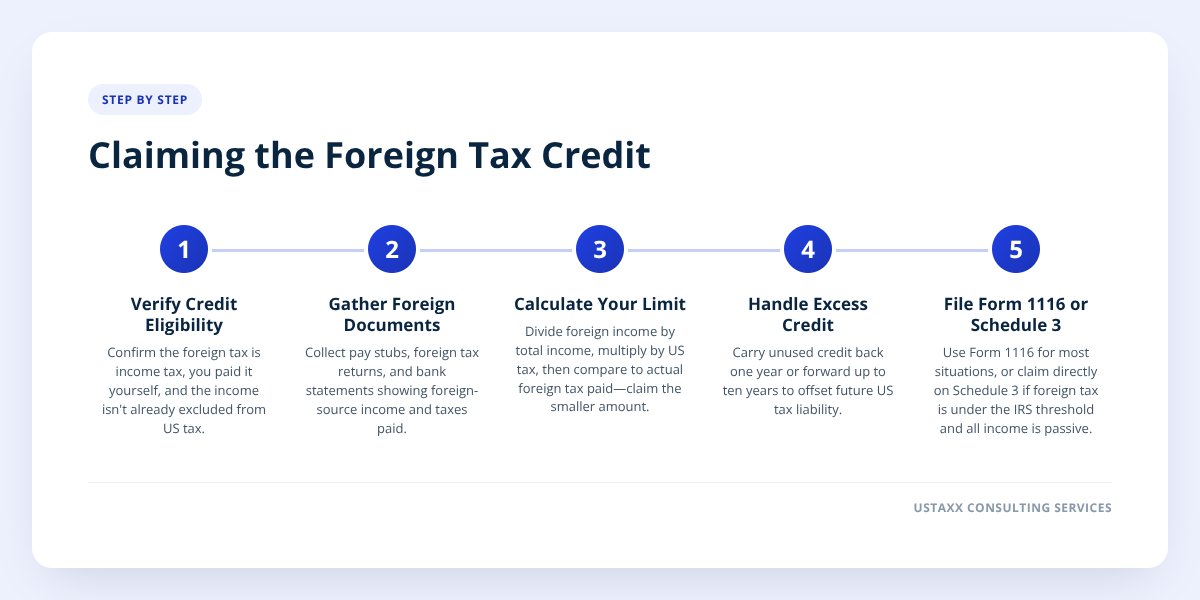
A careful review of your foreign income documents — pay stubs, foreign tax returns, bank statements — is usually where tax preparation starts for someone in this situation, since the credit calculation depends entirely on getting the foreign-source income and foreign tax paid lined up correctly.
How Does Form 1116 Actually Work?
Form 1116 calculates your credit by comparing the foreign tax you paid to a limit based on how much of your total US tax is attributable to foreign-source income. You don't just claim the full amount you paid abroad — the credit is capped.
Here's the basic math the form walks through:
- Figure your total foreign-source taxable income.
- Divide that by your total taxable income to get a ratio.
- Multiply that ratio by your total US tax liability before credits. That's your credit limit.
- Compare the limit to the foreign tax you actually paid. You can claim whichever is smaller.
A worked example: Say a taxpayer has $70,000 in total taxable income, of which $20,000 came from wages earned in Germany, and they paid $4,500 in German income tax on that income. Their foreign-source ratio is $20,000 ÷ $70,000, or roughly 28.6%. If their total US tax before credits is $8,000, the limit works out to about $2,286. Even though they paid $4,500 abroad, they can only credit $2,286 this year — the rest carries forward.
That carryover is the detail people miss. According to IRS instructions for Form 1116, unused credit can be carried back one year or forward up to ten years, so the $2,214 left over in the example above isn't lost — it can offset US tax in a future year when the limit is higher or foreign tax paid is lower.
Form 1116 also sorts income into separate categories — general category income (most wages and business income) and passive category income (most interest, dividends, and rents) are the two most common — and the limit is calculated separately for each category. Someone with both a foreign salary and foreign investment income will typically need to work through the form twice.
Do You Even Need Form 1116?
Not always. The IRS allows you to claim the foreign tax credit directly on Schedule 3 without filing Form 1116 if you meet all of the following, per the Form 1116 instructions:
- All of your foreign-source income is passive income, such as interest or dividends.
- That income, along with the foreign tax paid on it, is reported to you on a qualifying payee statement — typically a 1099-DIV or 1099-INT with foreign tax shown in the appropriate box.
- Your total creditable foreign taxes for the year don't exceed a set dollar threshold that differs for single and joint filers.
This simplified route is common for immigrants who still hold a brokerage account or mutual fund in their country of origin and receive a 1099 showing foreign tax withheld on dividends. If your situation is limited to a foreign account rather than foreign wages, it's also worth confirming separately whether you have an FBAR filing obligation — that's a different requirement from the foreign tax credit, tied to the value of foreign accounts rather than the tax paid on them. USTAXX walks through foreign-account reporting questions with clients as part of preparing the return, though the FBAR itself (FinCEN Form 114) is filed separately with the Treasury's Financial Crimes Enforcement Network, not through USTAXX.
Don't skip this: The foreign tax credit and the foreign earned income exclusion cannot both apply to the same income. Claiming the exclusion on wages earned abroad and then also crediting foreign tax paid on those same wages is double-dipping the IRS does not allow — you have to pick a lane for each dollar.
Foreign Tax Credit vs. Foreign Earned Income Exclusion: Which Saves More?
The better choice depends on your foreign tax rate relative to the US rate, and whether you want a refundable-style credit history or a straightforward income exclusion. The foreign earned income exclusion (FEIE), claimed on Form 2555, lets qualifying taxpayers exclude a set amount of foreign-earned wages or self-employment income from US tax entirely — the exact dollar limit is indexed for inflation each year, so confirm the current figure on the IRS Form 2555 instructions before filing.
| Foreign Tax Credit (Form 1116) | Foreign Earned Income Exclusion (Form 2555) | |
|---|---|---|
| What it does | Credits tax paid abroad against US tax owed | Excludes a capped amount of foreign wages from US tax |
| Best when | Foreign tax rate is close to or higher than the US rate | Foreign tax rate is low or zero |
| Unused benefit | Carries forward up to 10 years, back 1 year | Lost if not used that year — no carryover |
| Covers passive income | Yes (dividends, interest, rents) | No — earned income only |
| Eligibility test | No residency test required | Requires passing a bona fide residence or physical presence test |
| Can refund child tax credit math | Doesn't reduce earned income for other credits | Can reduce or eliminate eligibility for some earned-income-based credits |
As a general rule, taxpayers in high-tax countries — much of Western Europe, for example — often come out ahead with the credit, since the foreign tax paid frequently exceeds or matches what the US would have charged. Taxpayers in low-tax or no-tax countries often do better with the exclusion, since there's little or no foreign tax to credit in the first place.
It's also possible to use both in the same year on different income: exclude wages up to the FEIE limit with Form 2555, then claim the foreign tax credit on the remaining wages above that limit and on any passive foreign income. This combination strategy requires care, since the exclusion changes the denominator used in the Form 1116 limit calculation.
What Records Do You Need to Claim the Credit?
You need documentation that ties the foreign tax paid directly to the income it was assessed on — the IRS can disallow the credit without it. Keep these on hand before you file:
- Gather your foreign tax return or its equivalent, translated if not in English.
- Collect pay stubs or an employer letter showing foreign wages and tax withheld.
- Save 1099-DIV or 1099-INT forms showing foreign tax withheld on US brokerage statements, if applicable.
- Convert foreign currency amounts to US dollars using a consistent, documented exchange rate for the tax year.
- Note the foreign tax category (general vs. passive) for each item of income.
- Hold on to proof of payment — a receipt, bank record, or withholding statement — in case of an IRS inquiry.
Missing documentation is the most common reason a foreign tax credit claim gets questioned. If you've also got unfiled prior-year returns because foreign income made things complicated, that's worth addressing separately — see our guide on unfiled tax returns and back taxes for how that process works.
Claiming the foreign tax credit correctly means getting the category, the conversion rate, and the limit calculation right the first time, since an error can mean leaving a carryforward on the table for up to ten years. Book a consultation with USTAXX to go through your foreign income and tax documents before you file.
Checklist: Claiming the Foreign Tax Credit
- Confirm the foreign tax was an income tax, not a VAT, sales tax, or property tax.
- Determine whether your foreign tax falls under the $300/$600 threshold that allows claiming without Form 1116.
- Sort each item of foreign income into general category or passive category.
- Calculate your foreign-source income ratio and apply it to your total US tax to find your credit limit.
- Compare the limit to the tax actually paid and claim the lower amount.
- Document any unused credit for carryback or carryforward tracking.
- Check whether Form 2555 would produce a better result than Form 1116 for your wage income.
- Confirm separately whether your foreign accounts trigger an FBAR filing requirement.
Related articles
Blog by Segeo — new article every day.
Keep reading
The Substantial Presence Test: Are You a U.S. Tax Resident?
The substantial presence test determines U.S. tax residency based on weighted day counts: 31 days in the current year plus 183 weighted days over three
Read article1099 vs W-2: What It Means for Your Tax Bill
W-2 workers have tax withheld and their employer pays half of Social Security and Medicare. 1099 contractors owe both halves themselves, quarterly.
Read articleOctober 15 Tax Deadline: What Happens If You Miss It
Learn what happens if you miss the October 15 tax deadline, including penalties for failure to file and failure to pay, and how to minimize the damage.
Read articleTax Preparation and Advisor Help in Illinois
Learn how to find and work with tax preparers in Illinois, from document intake to filing options and cost factors for different return complexities.
Read articleReady to optimize your tax strategy?
Our IRS-authorized experts specialize in complex tax preparation for owner-operators, gig workers, and small businesses.
Schedule Your Consultation