
How to File Back Taxes: Step-by-Step for Self-Employed
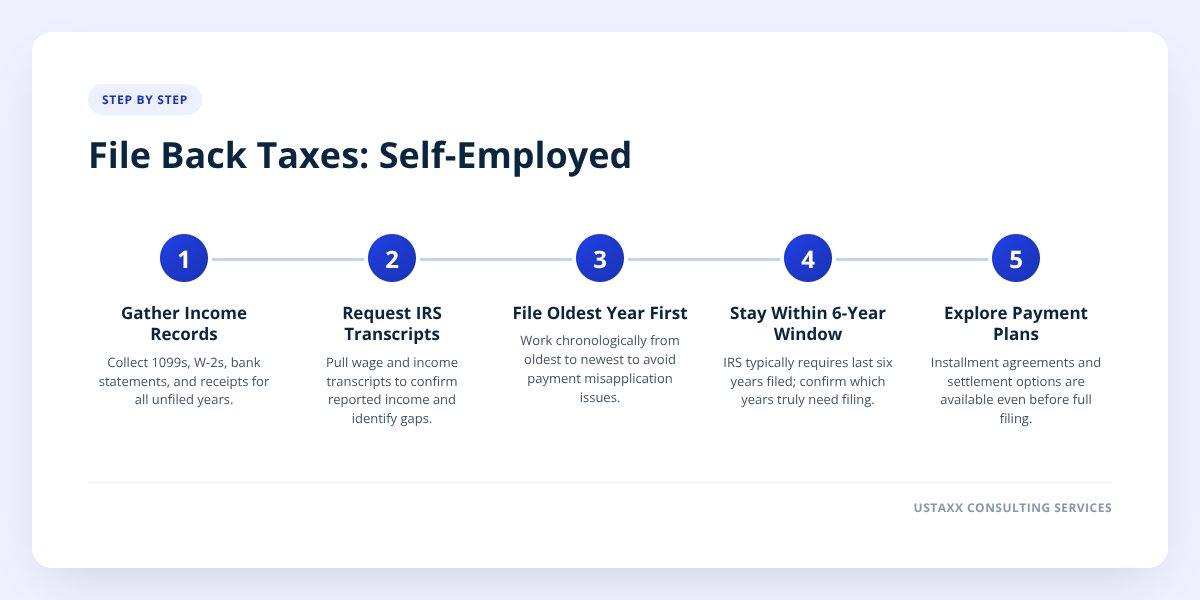
Quick answer: Start by pulling your income records for each unfiled year, then file the oldest year first and work forward in order. The IRS generally expects the last six years of returns to be considered "in good standing," according to IRS Policy Statement 5-133, and most people who come forward voluntarily are routed toward payment resolution, not prosecution. The real risk isn't the IRS knocking on your door — it's the penalties and interest that keep compounding the longer you wait.
Key takeaways
- The IRS typically requires the last six years of returns to be filed to be considered compliant, per IRS Policy Statement 5-133 — not all missing years back to your first paycheck.
- Filing older years first, in chronological order, avoids the notice confusion and mismatched payment applications that come from filing out of sequence.
- The IRS can file a Substitute for Return (SFR) on your behalf if you don't act — and it won't include deductions or credits you're entitled to, so your bill will be higher than if you filed yourself.
- Payment plans, including IRS installment agreements and Offer in Compromise, are available even before all back years are filed, but the IRS generally wants a return on file before it negotiates.
Why Hasn't the IRS Contacted Me Yet?
The IRS doesn't chase every unfiled return immediately, and that silence is often mistaken for safety. In reality, the agency's systems are simply slow to flag a gap, especially for self-employed people whose income isn't reported through W-2 withholding.
The IRS mainly detects unfiled returns through data matching — comparing 1099s, W-2s, and bank reporting against its master file of who has and hasn't filed. If you're a freelancer or small business owner whose clients issue 1099-NECs, that paper trail eventually catches up, sometimes years later.
What tends to trigger actual IRS action:
- A client or platform reports payments to you on a 1099, but no matching return shows up.
- You apply for a mortgage, SBA loan, or other financing that requires tax transcripts.
- You have a balance due from a prior year that's now drawing enforced collection attention.
- You proactively contact the IRS or a tax professional to get compliant.
That last point matters. Coming forward voluntarily, before the IRS opens a case, generally puts you in a far better position than waiting to be contacted. We cover the practical side of this in What Back-Tax Help Really Looks Like.
Don't skip this: the IRS can file a Substitute for Return (SFR) using only the income data it has on file — with no deductions, no dependents, and no business expenses applied. That return almost always overstates what you actually owe, and it starts the clock on collection action.
What Records Do You Need Before You File?
You need every income record for each unfiled year, plus documentation for any deductions you're claiming — bank statements alone won't cut it for a self-employed return. Gathering this before you start filing prevents the back-and-forth that stretches a two-week process into two months.
For each missing year, start collecting:
- Request wage and income transcripts from the IRS, which show every 1099, W-2, and 1099-K reported under your Social Security number or EIN.
- Gather business bank and credit card statements to reconstruct income and expenses if your bookkeeping lapsed along with your filings.
- Collect receipts or statements for major deductions — home office costs, vehicle mileage, equipment, contractor payments.
- Pull prior-year tax software files or paper returns if you filed some years but not others.
- Note any estimated tax payments you made, even informally, so they get credited correctly.
- Confirm your current mailing address matches IRS records, since notices for back years often get sent to the address on file.
If your records are incomplete, an IRS wage and income transcript is usually the fastest way to reconstruct a missing year, since it pulls directly from what employers and clients already reported.
Which Year Should You File First?
File the oldest unfiled year first and move forward chronologically, not the most recent year or the one you're most worried about. Order matters for a few concrete reasons.
Filing in sequence keeps your account transcript coherent. The IRS applies payments and calculates penalties based on the order returns are processed, and filing a recent year before an older one can cause the agency to misapply a payment or generate a confusing notice about a "missing" prior return.
There's also a hard boundary worth knowing: the IRS generally only requires the last six years of returns to be filed to be considered current, per its Policy Statement 5-133. If you have eight or ten years of gaps, that doesn't mean all of them need to be filed — a tax professional can help determine which years actually need attention versus which fall outside the compliance window.
| Filing scenario | Typical approach |
|---|---|
| 1–3 years unfiled | File all years, oldest to newest, in one batch |
| 4–6 years unfiled | File all years within the compliance window; confirm nothing older is being actively pursued |
| More than 6 years unfiled | Confirm with the IRS or a preparer which years are required before filing everything |
| Refund year buried in the gap | File it anyway — but note refunds are generally only paid if claimed within three years of the original due date |
That last row deserves its own mention. If one of your unfiled years would have resulted in a refund, the IRS generally will not pay it if you file more than three years past the original due date. That refund isn't a penalty waiting to happen — it's money that simply expires.
What Payment Options Exist If You Owe?
You don't have to pay the full balance before you file, and you don't need every year filed before you start talking to the IRS about payment. The two generally move together, but the agency does have structured programs for people catching up.
- IRS Installment Agreement — a monthly payment plan, available online for balances under a set threshold, that stops most aggressive collection action while you pay down what's owed.
- Currently Not Collectible status — if you can show the IRS that paying anything would create genuine financial hardship, collection can be paused, though interest continues to accrue.
- Offer in Compromise — a negotiated settlement for less than the full balance, available in specific hardship situations and generally requiring all required returns to be filed first.
- Penalty abatement — the IRS's First-Time Abate program can remove failure-to-file and failure-to-pay penalties for taxpayers with a clean compliance history in the prior three years, according to the IRS's own penalty relief guidance.
Penalty relief is often the biggest lever available to someone with multiple back years, because failure-to-file penalties accrue faster than failure-to-pay penalties — up to a combined 5% of the unpaid tax per month according to the Internal Revenue Code's penalty structure, capped at 25%. Filing even without paying in full stops that specific penalty from growing further. We go deeper on this in IRS penalty relief situations and what qualifies.
What Happens After You File Back Returns?
Expect a series of IRS notices over the following months, not an immediate resolution — the system processes each year separately and communicates through mail, not phone calls. Knowing what's normal versus what needs a response keeps this from feeling like an open-ended threat.
Typical sequence after filing:
- CP14 notice — a balance-due notice for each year that shows tax owed after your return posts; this is routine, not a sign of trouble.
- Transcript updates — your account transcript for each year updates to show the return as filed and any SFR previously entered is reversed.
- Payment plan confirmation — if you requested an installment agreement, expect written confirmation within a few weeks.
- Occasional review or audit selection — most back-year filings post without extra scrutiny, but a return with unusual deductions or large swings in income can be selected for review like any other return.
If a notice arrives, read it carefully before reacting — most are informational, not urgent, and we break down exactly how to tell the difference in How to Read an IRS Notice Without Panicking. The notice number in the top corner tells you what kind of letter it is, and that single detail usually answers whether it needs a same-day response or just a filed copy for your records.
For self-employed filers specifically, getting current also resets your footing for future years — accurate quarterly estimates, correct expense tracking, and a clean transcript that won't complicate a future loan application or LLC filing. If you're newer to self-employment and want to understand what's different about your filing obligations going forward, Self-Employed Tax Preparation: What to Expect Your First Year covers what changes once you're filing on your own.
What to Do Next
Getting current with the IRS is a sequence, not a single event — records first, oldest year first, then payment resolution once the returns are on file. The process is well-documented and the outcomes are far more predictable than most people assume before they start.
USTAXX Consulting Services handles back-tax and unfiled-return resolution for self-employed individuals and small business owners across all 50 states, with a free 30-minute initial consultation to review which years need attention and what payment options apply. If you've been putting this off, the next step is simply pulling your records together — everything after that gets easier.
Checklist: Filing Back Tax Returns
- Request IRS wage and income transcripts for every unfiled year.
- Gather bank and credit card statements to reconstruct self-employment income.
- Collect receipts for deductible expenses — home office, mileage, equipment, contractor pay.
- Confirm your current address matches IRS records before returns are mailed or processed.
- Identify which years fall within the IRS's six-year compliance window.
- File the oldest unfiled year first, then move forward chronologically.
- Check whether any unfiled year would have produced a refund, and confirm the three-year claim deadline.
- Request an installment agreement or penalty abatement once returns are filed and a balance is confirmed.
- Read each IRS notice by its number before responding or ignoring it.
Related articles
Blog by Segeo — new article every day.
Keep reading
Tax Preparation and Advisor Help in Illinois
Learn how to find and work with tax preparers in Illinois, from document intake to filing options and cost factors for different return complexities.
Read articleQuarterly Estimated Taxes Explained for the Self-Employed
Self-employed and expecting to owe $1,000 or more? You must pay estimated tax quarterly. The 2026 due dates, how to size each payment, and the penalty.
Read articleHow to File Back Taxes: A Step-by-Step Walkthrough
Gather each missing year's income records, pull IRS transcripts for what you can't find, use that year's forms, and file before the IRS files a return for you.
Read articleBack Taxes HelpHow to File Back Taxes in 2026: Stop IRS Penalties on Unfiled Returns
Missed personal or business returns? Here's exactly what the IRS does next — substitute returns, escalating penalties, liens and levies — and how to get compliant before it gets worse.
Read articleReady to optimize your tax strategy?
Our IRS-authorized experts specialize in complex tax preparation for owner-operators, gig workers, and small businesses.
Schedule Your Consultation