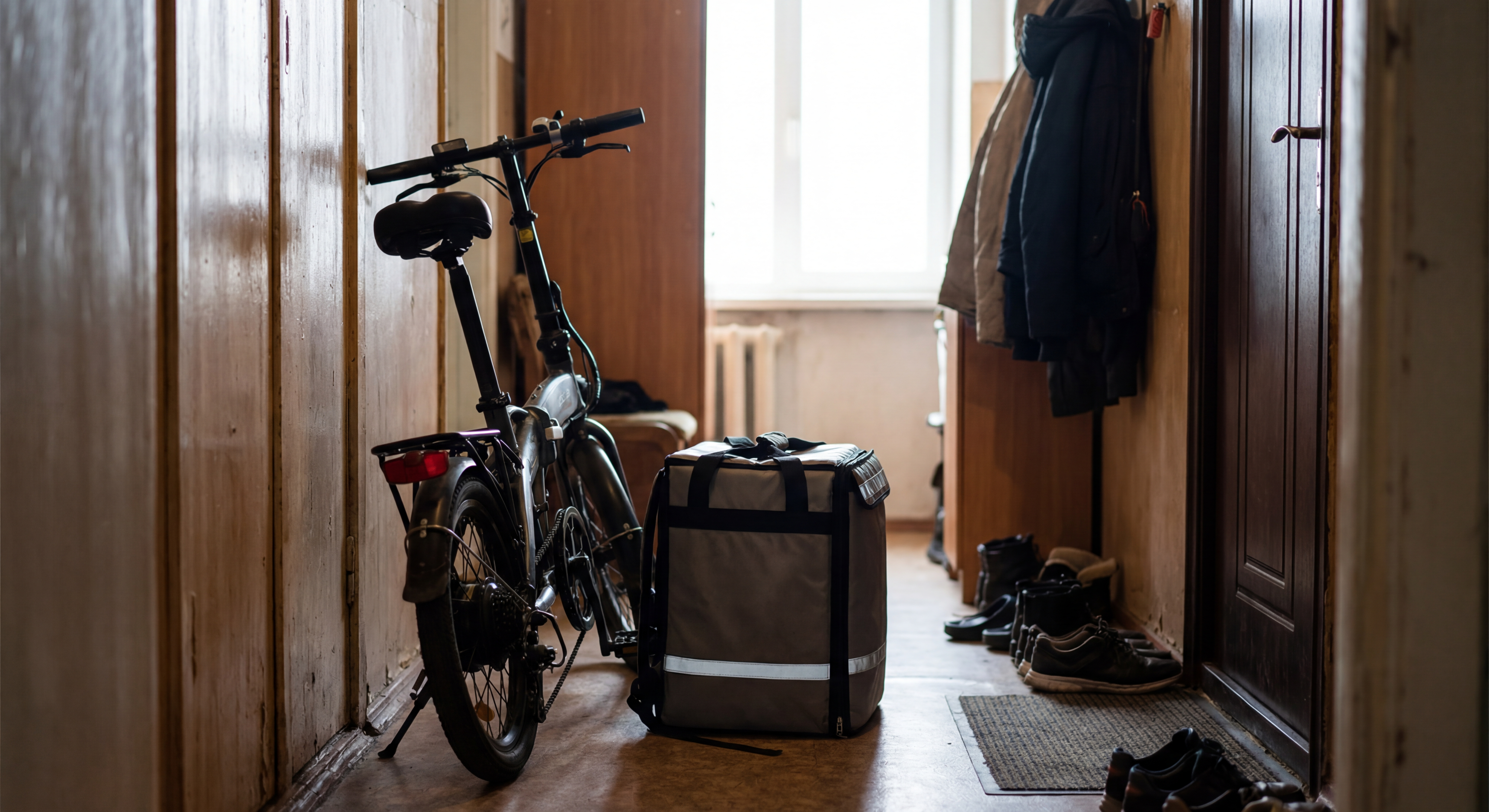
The Tenways CGO Compact: A $2,150 Deductible Asset Solving the Gig Worker's Storage Problem
The Tenways CGO Compact: A $2,150 deductible asset solving the gig worker's storage problem
You're inside a Chipotle, eyes darting between the app and the street sign where your livelihood is locked up. It's a $2,000 gamble every time you pick up an order. But bringing a standard e-bike inside is a different kind of headache—one involving cramped elevators, hostile property managers, and hallways that weren't built for wide handlebars. This isn't just an annoyance; it's a financial vulnerability. According to Project 529 (2025), a bike is stolen every 30 seconds in North America, siphoning millions from the gig economy every year.
Tenways launched the CGO Compact in Europe on February 13, 2026, specifically to solve this geometric mess. The tech press is busy swooning over the twisting stem, but for USTAXX clients, the real story is the balance sheet. At €1,999 (roughly $2,150 USD), this bike is a Capital Asset that can lower your taxable income while slashing your daily overhead by nearly 85% compared to a car.
For anyone looking for gig worker deductions, this is a hardware shift. It fits in a trunk, handles stairs, and carries 59 pounds of cargo. But with federal tax credits currently stalled, the way you report this purchase on your Schedule C matters more than the bike's motor.
What this means for your business
- The hardware: The bike has a stem that twists 90 degrees and pedals that fold flat. This slims the profile so it can hug a wall in a narrow hallway.
- The savings: You can save between $9,000 and $13,500 annually in operational costs by ditching a car for an e-bike, per AAA's 'Your Driving Costs' 2025 Report.
- The tax hit: There is no federal e-bike tax credit in 2026. You have to treat this as a capital expense or business deduction to see any money back.
- The compliance: LLC owners need to document their business usage percentage meticulously to survive an IRS audit.
The apartment problem solved (operational efficiency)
Minutes spent hunting for a safe parking spot or wrestling with heavy U-locks are minutes you aren't being paid for. Tenways built the CGO Compact to vanish into spaces where professional bikes usually can't go.
Twist-and-Fold Technology is a mechanical system that allows the handlebars to rotate 90 degrees and pedals to collapse, slimming the bike's width for indoor storage or car trunk transport. This addresses the "last-meter" logistics hurdle that costs drivers an average of 12 minutes per shift.
As reported by The Verge (February 13, 2026), the bike uses that twistable stem and 20-inch wheels to create a "slim, wall-hugging profile." For a DoorDash or Uber Eats driver in a walk-up, this is the difference between keeping your bike and losing it to a pair of bolt cutters. You bring the asset inside.
Thomas Ricker, Deputy Editor at The Verge, points out that the adjustable steering column makes the bike easy to share, but the real utility for a business owner is the MIK HD rear carrier. It holds 27kg (59.5 lbs), which is plenty for a double order or a heavy grocery run. Unlike flimsy folding commuters, this one keeps the payload capacity you need for commercial work.
The financial argument: gas vs. electrons
Gas prices are a rollercoaster; electricity is a flat line. When we compare professional tax prep vs DIY software, we start with your Cost Per Mile (CPM).
- Gas Vehicle CPM: ~$0.72 (AAA, 2025)
- E-Bike CPM: ~$0.08 - $0.10 (Energy Information Administration data)
A 2025 analysis by HOVSCO and AAA data suggests delivery drivers save between $9,000 and $13,500 every year by switching modes.
The CGO Compact swaps a chain for a Gates Carbon Belt drive. Georg Grieshaber of eBikeNews calls it a "thoughtful package with belt drive," and the maintenance math backs him up. Chains stretch, rust, and demand grease. Belts last three to four times longer and require zero lubrication. For a driver hitting 60 miles a day, that means less time in the shop and more time earning.
The tax reality: write-offs, not rebates
Don't listen to the social media rumors about government checks for e-bikes. In 2026, the landscape is much more rigid.
No federal safety net Contrary to the hype, there is no active federal tax credit for two-wheeled e-bikes in 2026. The proposed 'E-BIKE Act' is still gathering dust in Congress. Mark (EbikerMark), an industry analyst, puts it clearly: "For business owners, e-bikes can be fully deducted as a capital expense or written off via mileage, but do not expect a federal tax credit like the $7,500 EV credit in 2026."
State incentive volatility Even state-level help is drying up.
- Colorado: The state tax credit was cut by 50% on January 1, 2026, falling from $450 to $225 (Colorado Department of Revenue).
- California: The statewide program is closed but should reopen on May 29, 2026.
Your move: capital expense strategy
Since you can't lean on a rebate, you have to lean on tax optimization for LLC owners and sole proprietors.
- Section 179 expensing: You can often deduct the full $2,150 in the year of purchase, as long as the bike is used more than 50% for business. Section 179 is a tax code provision that allows businesses to deduct the full purchase price of qualifying equipment during the tax year regarding which the equipment was purchased.
- Actual expenses vs. mileage: You can't use the standard mileage rate for a bike; that is for cars. You have to deduct the actual costs: depreciation, repairs, insurance, and the electricity for charging. According to IRS Publication 463, "You cannot use the standard mileage rate for a vehicle that is not a car, such as a pickup truck, van, or motorcycle [or bicycle]."
This is why business advisory services are so important before you swipe your card. Sarah Jenkins, CPA and Senior Partner at TaxGlobal, warns: "If you mix personal and business use without a log, the IRS can disallow the entire deduction. The burden of proof is 100% on the taxpayer."
Comparison: delivery sedan vs. Tenways CGO Compact
| Feature | Used Gas Sedan (2018) | Tenways CGO Compact | Winner |
|---|---|---|---|
| Upfront Cost | $12,000 - $15,000 | ~$2,150 (€1,999) | Tenways |
| Fuel Cost/Mile | $0.15 - $0.20 | < $0.01 | Tenways |
| Parking Cost | $200+/month (City) | $0 (Apartment/Office) | Tenways |
| Tax Deduction | Standard Mileage Rate | Actual Expense/Depreciation | Context Dependent |
| Storage | Street/Garage | Hallway/Trunk | Tenways |
Why weight matters for compliance
The CGO Compact weighs 22kg (48.5 lbs). Weight matters because heavier "e-mopeds" often trigger rules requiring registration, insurance, and motorcycle licenses. Class 1 E-Bikes are low-speed electric bicycles with a top speed of 20mph and pedal assist only, and they are generally exempt from these hurdles (PeopleForBikes, 2025).
Staying under that moped threshold keeps your overhead low. You don't want to buy a vehicle that requires a specialized license just to deliver tacos. This bike hits a sweet spot: it's strong enough for cargo but is still just a bicycle in the eyes of the law.
While fleet owners worry about filing taxes for multiple states as truck driver regulations, gig workers have to worry about local asset security. This bike solves the physical problem. USTAXX handles the tax part.
Frequently asked questions
1. Can I deduct the full price of the Tenways CGO Compact on my taxes?
Yes, if used 100% for business. Under Section 179 of the IRS tax code, you can typically treat the e-bike as a capital asset and expense the full $2,150 immediately. However, if you use it for personal trips 30% of the time, you can only deduct 70% of the cost. You must keep a mileage log to survive an audit.
2. Is there a federal rebate for e-bikes in 2026?
No, the federal credit is inactive. The IRS confirmed that the tax credit for "qualified 2-wheeled plug-in electric drive motor vehicles" is not active for the 2026 tax year. Do not file assuming you will get 30% back from the feds; it will trigger an adjustment or audit.
3. I live in California; can I get help buying this?
Yes, starting May 29, 2026. According to the California Air Resources Board (CARB), the incentive program reopens in late May with a total budget of $13M. Income-qualified residents can receive vouchers up to $2,000. If you can wait until summer to buy, you might get the bike nearly free.
4. Is the bike heavy to carry up stairs?
It is lighter than average but still substantial. At 22kg (48.5 lbs), it is significantly lighter than the 60-70 lb average for delivery e-bikes, but lifting 50 pounds up three flights of stairs is still a workout. The twist-stem feature helps it fit in elevators, which is the preferred method.
5. Does the Tenways CGO Compact qualify as a vehicle for the Standard Mileage Rate?
No. The IRS restricts the Standard Mileage Rate (approx. 69 cents/mile in 2026) to cars, vans, and pickups. E-bike owners must use the Actual Expense Method, documenting the cost of the bike, repairs, and electricity separately.
Need Help With Your Taxes?
Our IRS-authorized team specializes in trucking, LLC, and small business tax preparation. Get expert help today.
Get Started